

Small body tracklet linking and orbit fitting#
Important
The discovery campaign described on this page ran as part of Prompt Processing, not the DP2 Data Release processing; we present it here to give a general overview of how Rubin discovers asteroids on a continuous basis. Objects discovered by Rubin and reported to the MPC before the DP2 association cutoff may appear in the DP2 known-object products, but DP2 does not deliver a standalone catalog of Rubin discoveries or Rubin-derived orbits.
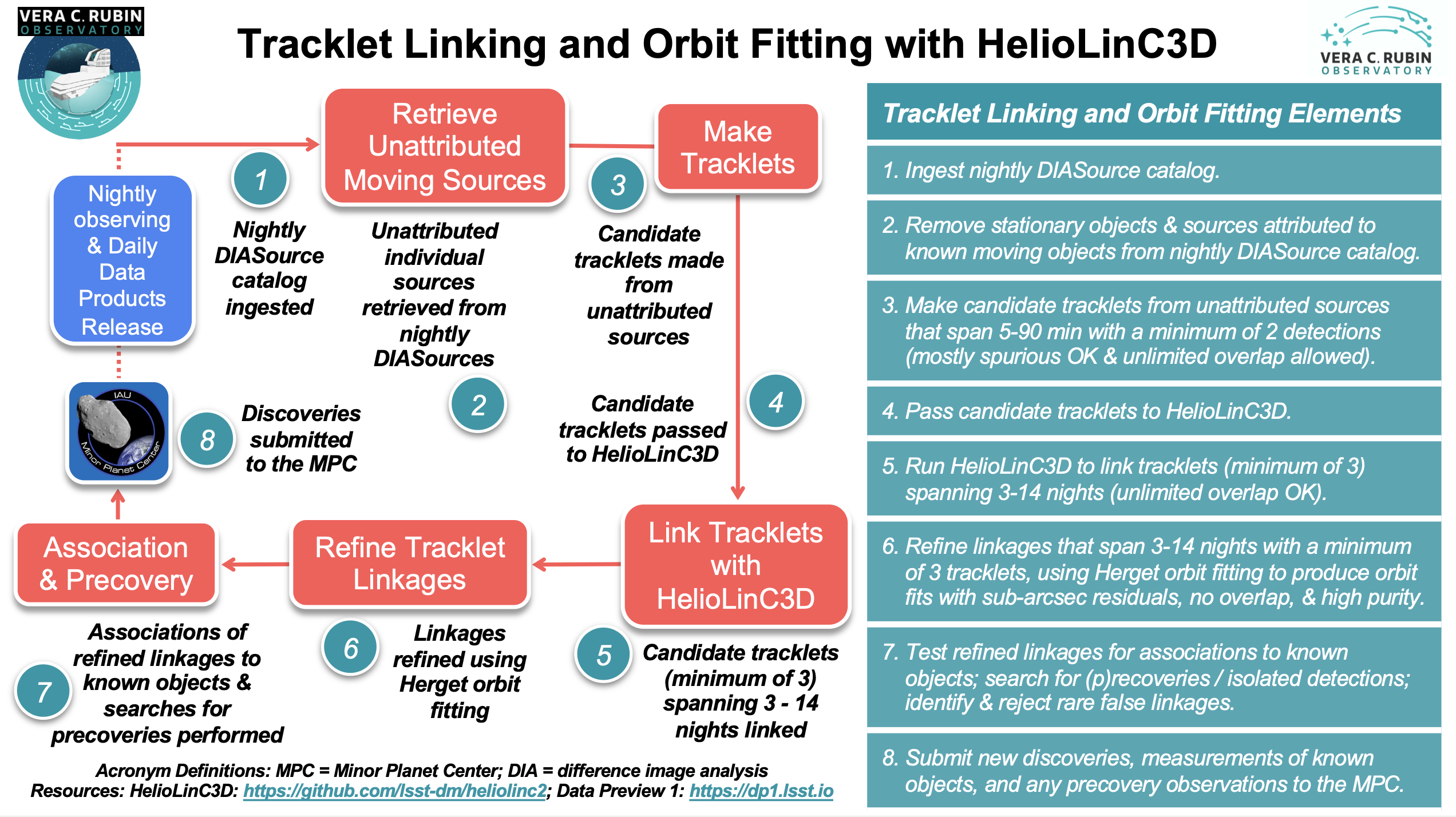
Small body tracklet linking and orbit fitting is done with the HelioLinC3D package.
The goal of the HelioLinC3D software package is to discover previously unknown asteroids amid the millions of new difference-image detections every night. The algorithm identifies and links together little sequences of typically 6-20 sources that could comprise repeated detections of a new asteroid moving in its orbit around the Sun.
These sets of detections (called ‘linkages’) are formed in two stages. First, ‘tracklets’ of observations are identified, where a tracklet comprises at least two images within a single night. Next, tracklets from multiple nights are linked together. LSST specifications state that a valid linkage must include at least three tracklets, each from a different night, and all within a 14-day period. Each linkage meeting these criteria constitutes a candidate asteroid discovery.
After the full set of candidate linkages has been produced, they are culled and refined through orbit fitting and other analyses. The final product is a purified set of thousands of non-overlapping linkages, each of which has an orbit-fit with sub-arcsecond astrometric residuals. These linkages – each comprising a probable new asteroid discovery – are submitted to the Minor Planet Center (MPC) for confirmation and publication. The tracklet linking and orbit fitting procedure is illustrated in the infographic provided above.